
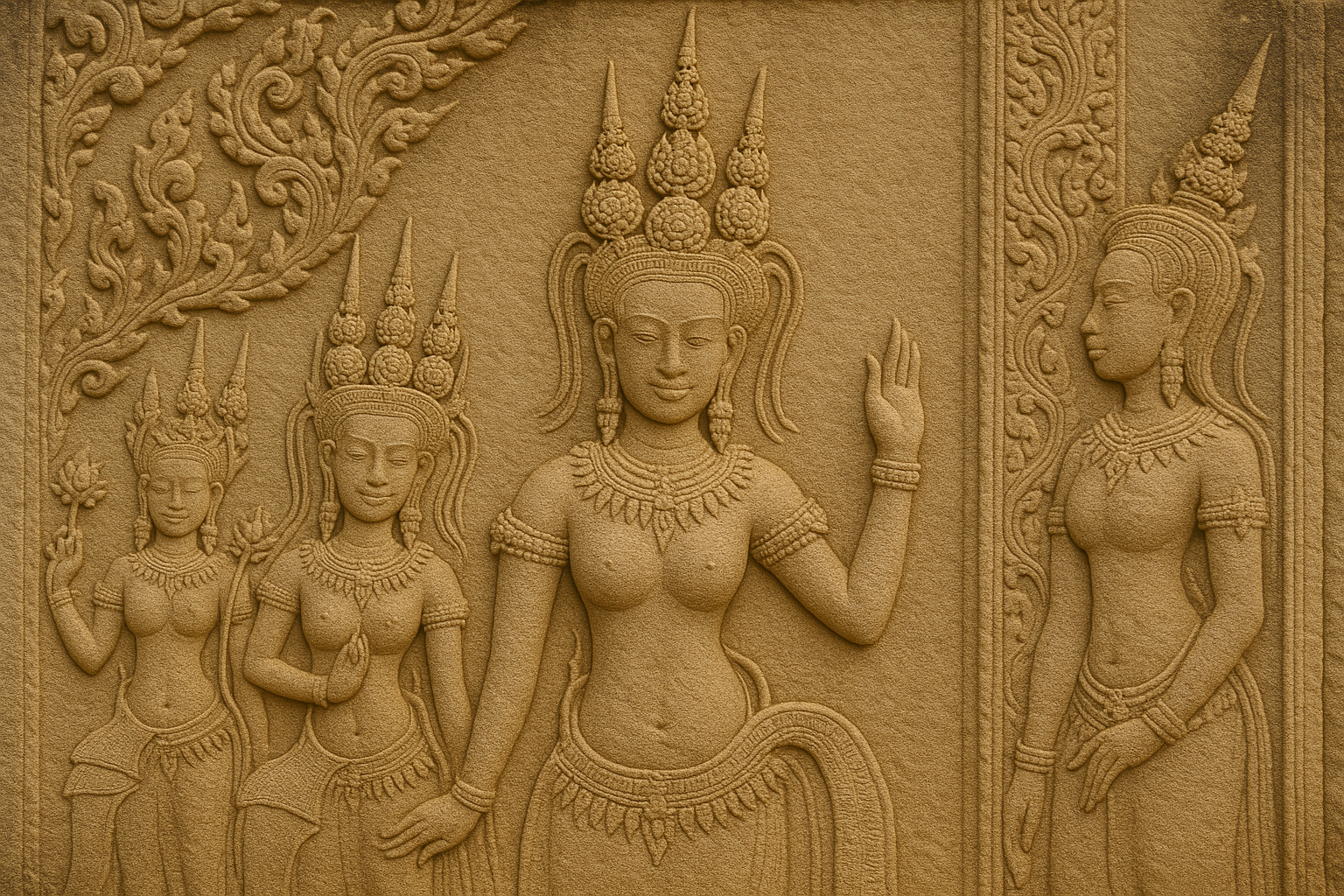
At first glance, the bas reliefs at Angkor Wat might seem like decorative carvings—but look closer, and they start to tell a powerful story. Stretching across hundreds of meters, these stone panels reveal how the Khmer Empire saw the world: through myth, history, and divine order. We walked the temple’s galleries in awe, realizing just how much insight these carvings offer into Cambodia’s most legendary civilization. Here’s what they reveal about Khmer religion, royalty, warfare, and worldview.
Explore Angkor Wat!
They Reflect a Kingdom Rooted in Hindu and Buddhist Beliefs
Most of Angkor Wat’s bas reliefs depict stories from Hindu epics like the Ramayana and Mahabharata—clear evidence of India’s spiritual and cultural influence on the Khmer elite. Gods like Vishnu, Shiva, Krishna, and Rama appear frequently, showing the empire’s strong Hindu foundation.
But the blend of iconography also hints at the later transition to Mahayana Buddhism, especially under King Jayavarman VII. The peaceful faces of Bayon and the compassionate nature of Avalokiteshvara reflect this shift. Religion wasn’t just personal—it was political, used to legitimize the ruler’s divine authority.
Some travelers memorialize their experience at Angkor Wat with a keepsake journal like this one thoughtfully designed for travelers who love capturing memories and documenting the history of Hindu and Buddhist beliefs.
They Show the Khmer Empire’s Political Power
In one of the most striking panels—the historical procession of King Suryavarman II—we see the monarch himself, surrounded by parasol-wielding attendants, generals, and war elephants. He’s depicted larger than anyone else, calmly overseeing his troops.
This wasn’t just art—it was propaganda. The carvings reinforced the idea of the king as a devaraja, or god-king, responsible for cosmic balance and earthly rule. Through these visuals, the Khmer Empire projected strength, stability, and divine legitimacy. You can book a guided Angkor Wat sunrise tour to see these royal processions carved in stone with a local guide.
Many travelers recommend an ultimate travel action camera like this for capturing stunning photos and videos of Angkor Wat in incredible detail.

They Reveal a Culture Obsessed with Cosmic Order
The Angkor Wat bas reliefs don’t just show epic battles—they show why those battles mattered. Stories like the Churning of the Ocean of Milk symbolize the eternal struggle between chaos and order, gods and demons. The universe, according to Khmer belief, was structured, hierarchical, and sacred.
This worldview is baked into the architecture itself—temples are laid out to reflect Mount Meru (home of the gods), surrounded by moats as the cosmic sea. The bas reliefs echo that sacred geometry, illustrating how the empire viewed its place in the cosmos.
For solo travelers or couples exploring Angkor Wat, a smart face-tracking phone tripod like this one can automatically follow your movement and help capture great videos hands-free.
They Document Military Might and Heroism
Several panels—like the Battle of Kurukshetra and the Battle of Lanka—are filled with movement, weapons, and war elephants. But these aren’t random scenes—they follow precise hierarchies and hero narratives, often showing noble warriors defeating evil.
These carvings may have doubled as historical allegory, equating the Khmer king’s victories with those of mythic heroes. They also hint at how the empire organized and celebrated military strength.
They Offer Glimpses of Daily Life
While the grand epics dominate, some panels reveal surprisingly human details—villagers farming, hunters with bows, markets, dancers, and musicians. These quiet moments paint a fuller picture of life under the Khmer Empire and show the artisans’ ability to capture the richness of their world.
It’s a reminder that this wasn’t just a kingdom of kings and gods—it was home to communities, rituals, and everyday beauty.
Since you’ll be outdoors visiting Angkor Wat, you may choose high-SPF sunscreen sprays like this one for extra protection against strong UV rays.
Angkor Wat’s Bas Reliefs
Angkor Wat’s bas reliefs are more than just stories—they’re the Khmer Empire’s worldview, values, and ambitions etched into stone. They reflect a civilization that blended religion with politics, myth with memory, and art with authority. To walk those galleries is to witness the mind and spirit of one of Southeast Asia’s greatest empires..
















Share your thoughts with us! Leave a Comment!