
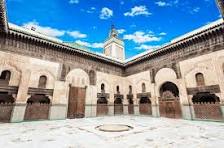
We walked into Bou Inania Medersas thinking it would be another beautiful historic building in Fes. Within minutes, we realized Bou Inania Medersas isn’t just beautiful — it’s layered, symbolic, and packed with details most people completely overlook. If you’re planning to visit Bou Inania Medersas, here’s how to see more than just the tiles.
Get To Know The Traveling Taylors!
Bou Inania Medersas Is More Than a Photo Stop
Built in the 14th century during the Marinid dynasty, Bou Inania Medersas functioned as both a religious school and a congregational mosque. That dual purpose already sets Bou Inania Medersas apart from many other medersas in Morocco. To frame the soaring courtyard without a crowd in your shot, a compact selfie stick tripod like this one comes in handy. If you would rather have the history explained on the spot, you can join a full-day guided tour of Fes.
When you first enter Bou Inania Medersas, your eyes immediately go to the central courtyard. The marble floor, carved cedar wood, and zellige tilework are undeniably stunning.
But don’t stop there.
Most visitors snap a few photos and move on. The real magic of Bou Inania Medersas is in the details above and around you.
Quick tip: Pause in the center of the courtyard and slowly look up.
The Cedar Wood Ceilings at Bou Inania Medersas
One of the most overlooked features of Bou Inania Medersas is the intricate cedar wood carving overhead.
The ceilings inside Bou Inania Medersas are covered in geometric and floral patterns, carved entirely by hand. Each panel reflects Islamic artistic principles — symmetry, repetition, and balance. Capturing that fine detail overhead is far easier when travelers bring a lightweight mirrorless camera like this one.
Look closely and you’ll see how the designs guide your eye upward, symbolically directing attention toward the divine.
At Bou Inania Medersas, the ceilings aren’t just decorative — they’re spiritual storytelling.
The Zellige Tilework at Bou Inania Medersas
The lower walls of Bou Inania Medersas are covered in colorful zellige mosaics. These tiles aren’t random patterns.
Traditional Moroccan zellige at Bou Inania Medersas follows complex mathematical geometry. The repeating shapes represent unity and infinity — key concepts in Islamic art. If you want steady, close-up shots of these shifting patterns, a smart face-tracking phone tripod like this keeps your camera perfectly still.
Notice how:
- The patterns become more intricate at eye level
- Colors shift subtly in different light
- No figurative imagery appears anywhere
Bou Inania Medersas relies entirely on geometry and calligraphy for artistic expression.
The Arabic Calligraphy Most Visitors Ignore
Above the tilework at Bou Inania Medersas, you’ll see bands of Arabic script carved into plaster.
These inscriptions often include Quranic verses and blessings. Even if you can’t read Arabic, pause and observe the fluid movement of the script.
At Bou Inania Medersas, calligraphy serves both aesthetic and spiritual purposes. The carved plaster feels almost lace-like when viewed up close.
Most travelers photograph the courtyard — but the calligraphy is where the deeper meaning lives.
Climb the Upper Level at Bou Inania Medersas
Another detail many people miss? The student rooms upstairs.
Climbing to the upper level of Bou Inania Medersas gives you a completely different perspective. From above, the courtyard symmetry becomes clearer, and the architectural precision stands out. Since the stairs are steep and the medina outside means hours on your feet, a pair of supportive walking sneakers like these makes the day far more comfortable. To wander those alleys with someone who knows them, you can book a guided walk through the Fez medina.
The small rooms once housed students studying theology. Standing in those simple chambers contrasts sharply with the ornate courtyard below.
Bou Inania Medersas balances grandeur with humility.
Best Time to Visit Bou Inania Medersas
Timing makes a difference at Bou Inania Medersas.
Early Morning: Fewer crowds, softer light filtering into the courtyard.
Midday: Brighter but busier.
Late Afternoon: Warm glow on wood carvings.
We found early morning allowed us to experience Bou Inania Medersas more quietly, making it easier to notice subtle details. During the busier midday hours in the crowded medina, many visitors keep valuables tucked away in a hidden RFID-blocking money belt like this one. If you would like a local to lead the way, you can reserve a private guided medina tour.
Plan to spend at least 45 minutes inside Bou Inania Medersas — rushing defeats the purpose.
Why Bou Inania Medersas Feels So Powerful
Bou Inania Medersas isn’t overwhelming in size — it’s powerful because of precision. Every inch of Bou Inania Medersas reflects intention: mathematical harmony, spiritual symbolism, and handcrafted mastery. It’s not just beautiful; it’s meaningful. If you visit Bou Inania Medersas and only capture wide courtyard photos, you’ll miss what makes it extraordinary. Slow down. Look up. Trace the patterns. Notice the calligraphy.
Bou Inania Medersas rewards attention — and once you see the details, you’ll never look at Moroccan architecture the same way again.











Share your thoughts with us! Leave a Comment!