
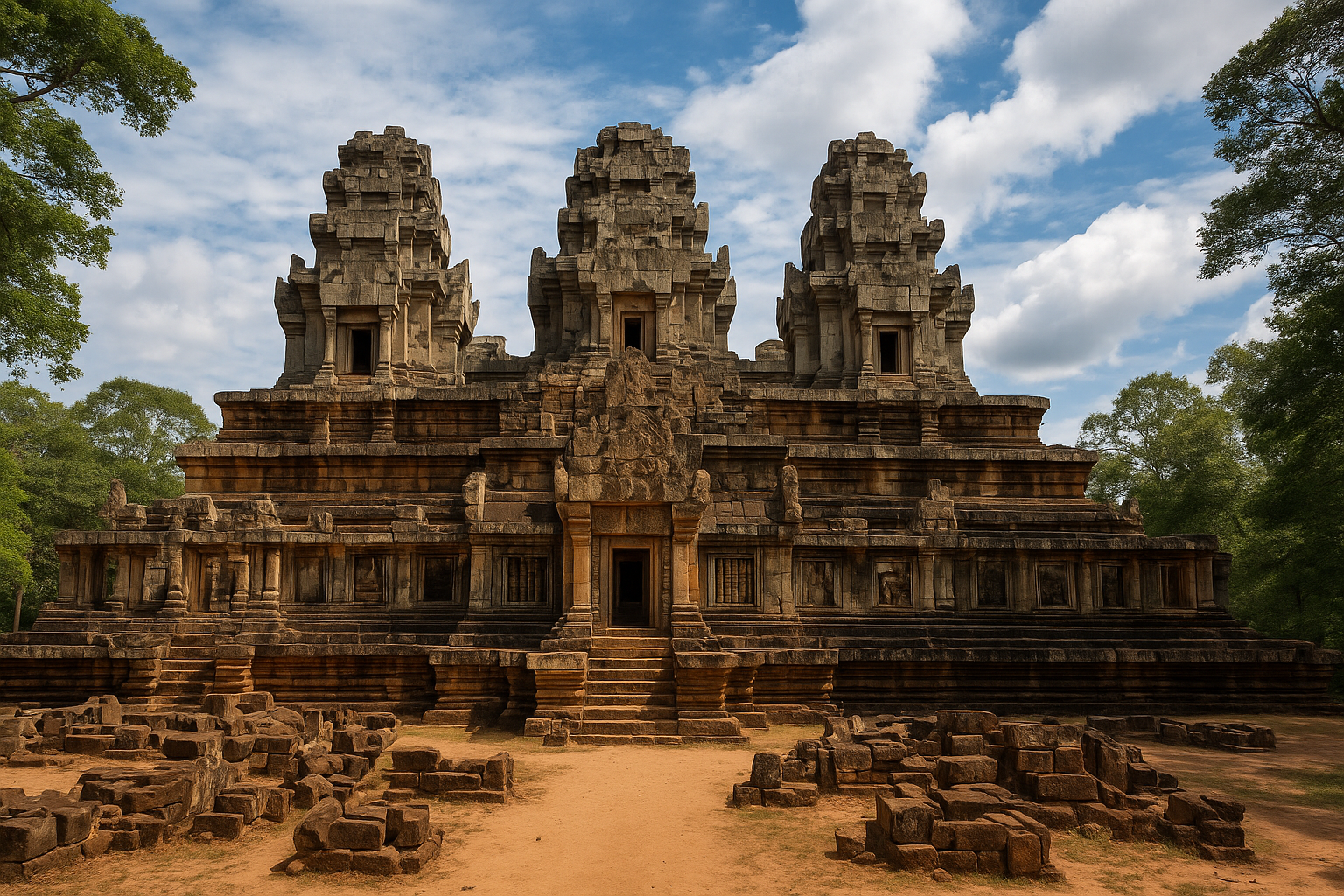
We stumbled upon Ta Keo almost by accident—tucked between bigger names like Ta Prohm and Angkor Thom, it doesn’t always make the must-see lists. But this massive, unfinished temple quickly became one of our favorite finds in the Angkor complex. Towering and austere, with no decorative carvings and dramatic staircases to climb, Ta Keo feels raw, adventurous, and strangely peaceful. If you’re looking for a temple that’s both crowd-free and climbable, this one deserves a spot on your route.
Experience Cambodia With Us!
Where Is Ta Keo Temple?
Ta Keo is located in the eastern part of the Angkor Archaeological Park, between the Victory Gate of Angkor Thom and Ta Prohm. It’s easy to fit into a standard Grand Circuit or temple loop itinerary—especially if you’re cycling or hiring a tuk-tuk. If you’d rather have a guide handle the route, you can join a small-group Angkor temples tour.
Why Ta Keo Stands Out
1. Its Towering Structure
Built from massive sandstone blocks, Ta Keo rises in five levels, with a central tower that reaches nearly 50 meters high. It was designed to resemble Mount Meru, the mythological center of the universe in Hindu cosmology.
2. You Can Still Climb It
Unlike many temples where access is restricted, you can still climb to the top of Ta Keo using its original, super-steep staircases. It’s not for the faint of heart (or bad knees), but the reward is a sweeping view and a quiet sense of accomplishment. If you enjoy filming your travel experiences, a tiny wearable camera like this one is a great way to capture hands-free POV footage while climbing the stone staircase to the top and the beautiful views of Angkor Archaeological Park once you’ve made it to the top.
3. Its Stark, Unfinished Beauty
Ta Keo is often called the “temple without carvings.” It was never fully decorated, which gives it a raw, monolithic feel. That lack of detail lets you focus on the scale, symmetry, and strength of the architecture.

The Mystery Behind Its Incompletion
Historians believe Ta Keo was built in the late 10th to early 11th century under King Jayavarman V. Construction suddenly stopped—possibly due to lightning striking the temple, which was seen as a bad omen, or the king’s death.
Whatever the reason, it remains unfinished, and that only adds to its intrigue. It’s like a giant sculpture paused mid-creation. Many travelers recommend an ultimate travel action camera like this for capturing stunning photos and videos of every adventure in incredible detail.
Tips for Visiting
- Wear sturdy shoes. The steps are tall, narrow, and worn smooth. Grip matters! Many women recommend these women’s durable leather hiking boots built for outdoor adventures with waterproof protection, slip-resistant traction, and cushioned arch support for climbing the stone staircases of Ta Keo. On the other hand, men recommend men’s hiking boots like these designed for comfort and durability with waterproof protection, slip-resistant traction, cushioned support, and rugged construction.
- Go early or late. There’s little shade at the top, and the midday sun can be brutal.
- Bring water. You’ll definitely break a sweat climbing to the upper tiers. Staying hydrated during long sightseeing days is important, so many travelers carry a collapsible water bottle like this one that folds flat when it’s empty.
- Take your time. Even without carvings, the geometry and construction are impressive.
- Watch your footing. There are no handrails, and the stairs are seriously steep.
Is It Worth Visiting?
Absolutely—especially if you love photography, architecture, or temples that feel a bit off the beaten path. Ta Keo offers a different kind of Angkor experience: less about intricate art, more about scale, solitude, and adventure.
You won’t find crowds here. You won’t find selfie sticks or food stalls. What you will find is one of the few Angkor temples where you can still feel like an explorer.
Ta Keo, the Unfinished Temple
Ta Keo might not have the fame of Angkor Wat or the cinematic charm of Ta Prohm, but it holds its own with powerful presence and climbable heights. If you’re craving something quieter and more physical during your temple tour, add this ancient mountain of stone to your list—you won’t regret the climb.
















Share your thoughts with us! Leave a Comment!