
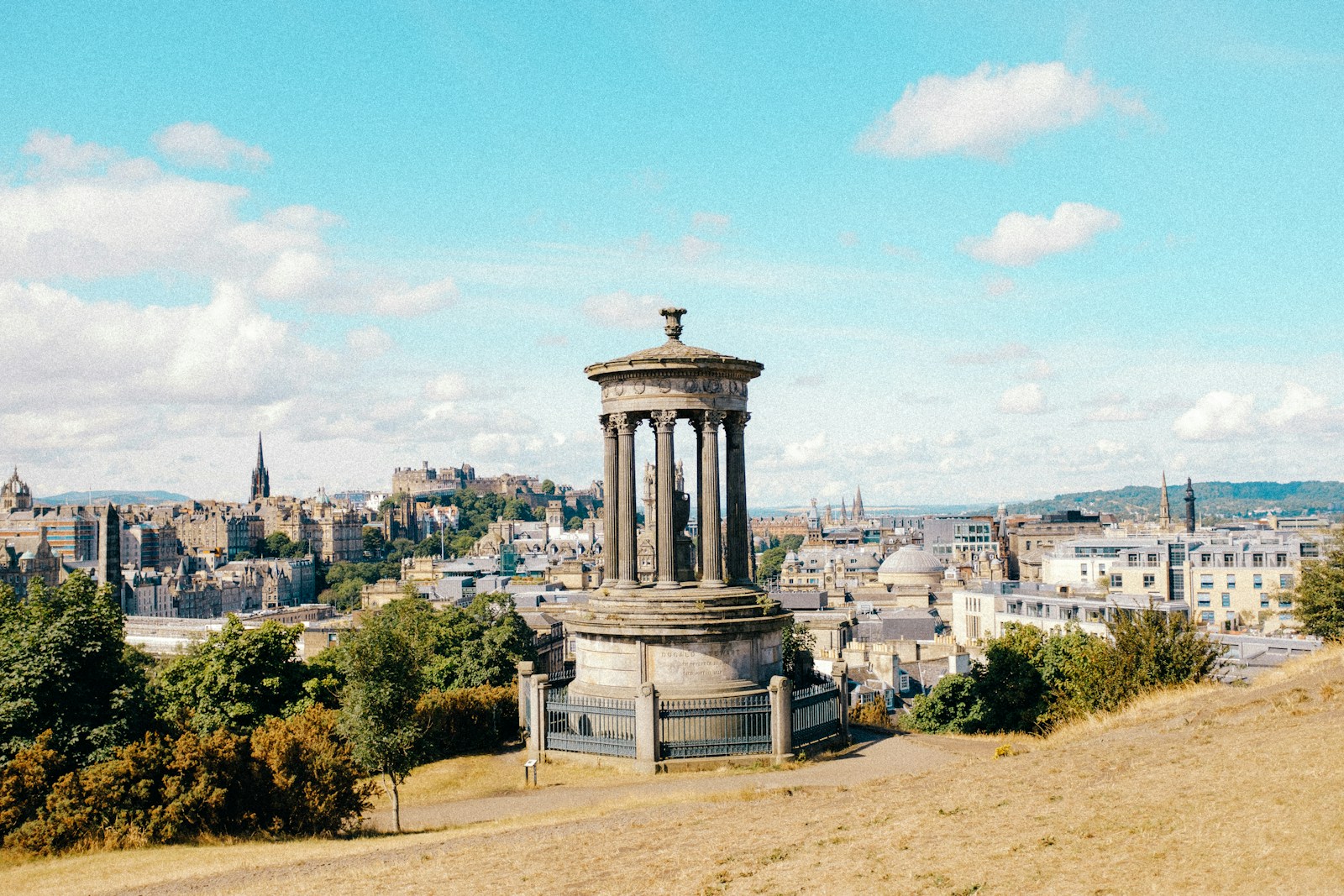
We first climbed Edinburgh Calton Hill for the view—because who can resist that skyline shot with the Dugald Stewart Monument in the foreground? But once we started digging into its history, we realized Calton Hill is more than just a photo stop. It’s one of the city’s most symbolic (and slightly rebellious) spaces, layered with secrets that most visitors never hear about. If you like your travel with a side of scandal, monuments, and unexpected trivia—this one’s for you.
Get To Know The Traveling Taylors!
Where Is Calton Hill, and Why Does It Matter?
Calton Hill sits just east of Princes Street, an easy 5–10 minute walk from the city center. You’ll recognize it by its cluster of neoclassical monuments, which rise above the skyline like something out of ancient Greece.
But beyond the dramatic architecture and panoramic views, Calton Hill has played a surprisingly big role in Edinburgh’s political, scientific, and artistic history.
It Was Once a Site for Public Punishment
In the 1600s, Calton Hill was used for executions—including the hanging of political prisoners and accused witches. The wide-open space made it ideal for crowds to gather. Creepy? Yes. But it’s part of what gives the hill its edge.
It Was Home to Scotland’s Radicals
In the early 19th century, Calton Hill was a gathering point for radical political reformers, especially those pushing for voting rights and social equality. Several fiery speeches and rallies were held here—earning the hill a reputation as a symbol of intellectual rebellion.
Why It’s Called “Edinburgh’s Acropolis”
This nickname isn’t just about the aesthetic. In the 1800s, city leaders planned to turn Calton Hill into a kind of mini Athens, celebrating Scottish Enlightenment ideals.
They started with the National Monument, designed to mimic the Parthenon in Greece. But they ran out of money—leaving it forever unfinished, earning it another nickname: “Edinburgh’s Disgrace.”
The Observatory Was Cutting-Edge… in 1818
One of the hill’s lesser-known gems is the City Observatory, designed by William Henry Playfair. When it opened in the 19th century, it was a hub for astronomy and science education.
Today, it’s been reimagined as Collective, a contemporary art space. You can still see the historic equipment—and enjoy art installations with that same epic view.
It’s a UNESCO World Heritage Site
Calton Hill is part of Edinburgh’s Old and New Town UNESCO designation. What makes it special is how it blends natural landscape with neoclassical architecture, giving the city one of the most distinctive skylines in Europe.
Famous Monuments You Might Not Know About
- Dugald Stewart Monument: The iconic circular structure, often mistaken for an ancient ruin, actually honors a Scottish philosopher.
- Nelson Monument: Climb to the top for a 360° view—and spot the time ball that still drops daily at 1 p.m.
- Political Martyrs’ Monument: A tribute to 5 men exiled for fighting for democratic reform in the 1790s.
Hidden Corners to Explore on Calton Hill
- 🌿 Back Path Loop: A quieter trail that wraps around the hill with unique skyline views.
- 🪑 Stone Benches: Scattered around the observatory—perfect for sunset picnics.
- 🏛 Old Royal High School: A striking building with a complicated political past (it was once considered for the Scottish Parliament).
Why Calton Hill Is More Than Just a Viewpoint
Edinburgh Calton Hill is stunning, no doubt. But what makes it unforgettable isn’t just the views—it’s the energy. It’s been a place of protest, learning, loss, and vision. A place where Scots looked to the stars, imagined new governments, and tried to build a monument that never got finished. If you want to feel Edinburgh’s soul, start here—and stay a little longer.











Share your thoughts with us! Leave a Comment!